Short form vs long form: what keeps kids coming back to a character
A 30 second clip can reach millions of children in a week, and almost none of them will remember the character a month later. A 7 minute episode reaches fewer children, and some of them will ask for it every evening.
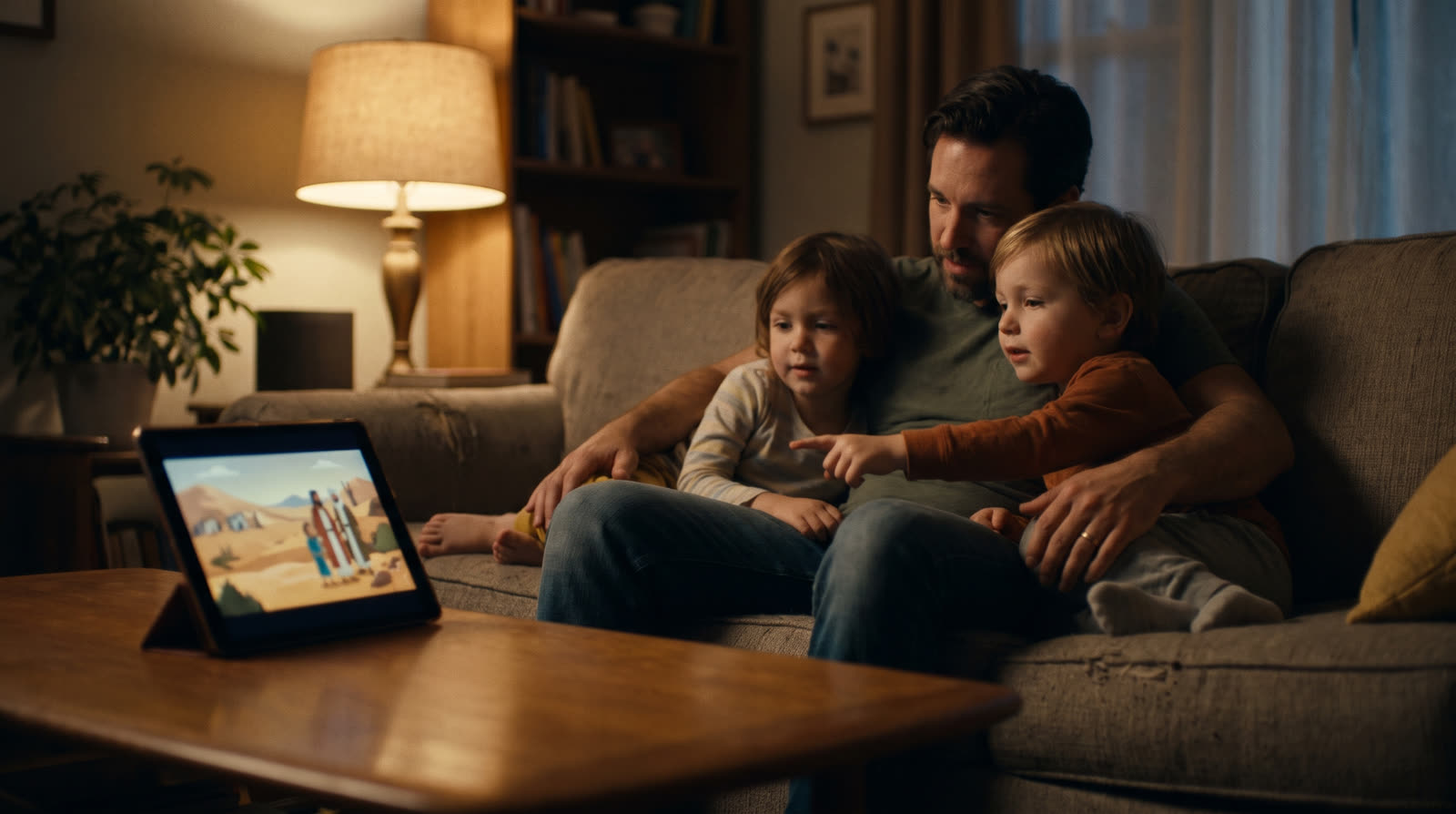
The short answer. Short form is for discovery and long form is for attachment. Short clips of 15 seconds to 3 minutes bring new children to a character, while episodes of 3 to 22 minutes give them a reason to come back. The efficient model in 2026 is one production that delivers both: the full episode, plus native vertical clips taken from it.
What is the difference between short form and long form for kids?
Short form is video of 15 seconds to 3 minutes, built for feeds such as YouTube Shorts, Reels and TikTok. Long form is an episode of 3 to 22 minutes, built for YouTube, kids platforms, streaming and TV. The two formats do different jobs, and the table compares them.
| Short form | Long form | |
|---|---|---|
| Length | 15 seconds to 3 minutes | 3 to 22 minutes |
| Job | Discovery | Attachment and habit |
| Where | Shorts, Reels, TikTok | YouTube, kids platforms, streaming, TV |
| Who chooses | The algorithm | The child or the parent |
| Measured by | Views and new followers | Watch time, replays, returning viewers |
Why should a kids series not choose only one format?
A single format strategy is a risk for a kids series in 2026, because each format fails on its own. Shorts alone build reach without attachment: children see a moment, not a character. Long form alone builds attachment slowly, because few children discover it. For example, a channel that posts only clips can reach large view counts with almost no returning viewers, while a channel that posts only full episodes may hold viewers well but grow slowly.
In practice, the best performing kids channels in 2026 use shorts as doors and episodes as rooms. Every clip points back to the episode it comes from.
Why does long form still matter for children in 2026?
Long form still matters because children spend long sessions with video at home. In the United Kingdom, children aged 4 to 15 spend 6 h 37 a week on YouTube (Ofcom 2024). YouTube's share of home viewing is 27% for children aged 4 to 6 and 49% for teenagers aged 13 to 15 (Ofcom 2025). Long sessions are where a child spends enough time with a character to care about it, and where replays happen.
Source: Ofcom, 2024 and 2025 (United Kingdom).
How can one production deliver every length?
One production delivers every length when short clips are planned in the script rather than cut afterwards. The method has four steps:
- Write moments: each episode holds 2 or 3 scenes that work alone, such as a joke, a song or a reveal.
- Produce natively: horizontal for the episode and vertical for the clips, composed for each screen rather than cropped.
- Point back: every clip leads to the full episode.
- Measure both: which clips bring new viewers, and which episodes keep them.
intranet stories delivers every episode natively in all formats, so the shorts and the full episode come from the same production and the same locked world.
Which format should a new kids series start with?
A launch mix is the combination of full episodes and short clips a series publishes in its first weeks, and in 2026 a new kids series should start with both formats from the first week. In practice, the first 3 or 4 full episodes give the channel something worth discovering, and 2 or 3 vertical clips per episode make those episodes discoverable. For example, a launch with 4 episodes of 7 minutes and 10 clips of 30 seconds gives the algorithm enough material to test, and gives every new viewer a full story to land on.
Frequently asked questions
Should a new kids series start with shorts or full episodes?
A new kids series should start with both. Shorts make the character discoverable on YouTube Shorts, Reels and TikTok, and full episodes make children stay. Producing both from the same episode keeps cost and consistency under control. For example, every 7 minute episode can produce 2 or 3 vertical clips that each point back to the full story.
What is the best episode length for kids on YouTube in 2026?
The best episode length on YouTube in 2026 is a function of age, not a single number. Preschool episodes usually run 3 to 7 minutes, and children aged 6 to 12 watch 11 minute episodes and longer compilations. In practice, producers should test 2 lengths in the first month and read average view duration and replays in YouTube Studio before fixing the format for the season.
Do shorts cannibalise full episodes?
Cannibalisation is the risk that short clips replace the full episode, and in 2026 shorts do not cannibalise full episodes when each short points to the episode it comes from. Shorts work as trailers for the story. In practice, the risk appears only when clips tell the whole story on their own, so the best clips show a moment, a joke or a song, and leave the resolution in the full episode.
Can short clips be cut from any animated episode?
Short clips work best when the episode is written with self contained moments and produced natively for vertical screens. Clips cropped afterwards from a horizontal master often lose characters at the edges of the frame. At intranet stories, every episode is delivered natively in all formats, so vertical clips are composed for phones from the start.